Introduction
You are driving through a new development in Pooler or Bluffton. You pass a shiny billboard that reads: “Luxury Custom Homes from the $500s!”
Intrigued, you pull into the sales center. You tour the model home, which looks beautiful. You sit down with the sales agent (who is very friendly) and say, “We love the ‘Magnolia’ floor plan, but we want to move the kitchen to the other side of the house to capture the marsh view, and we want to make the garage three feet wider for my workbench.”
The sales agent’s smile falters. “Oh, we can’t do that,” they say. “But you can choose between our ‘Gold’ or ‘Platinum’ cabinet packages!”
This is the moment of realization. You aren’t buying a custom home. You are buying a Production Home with a few cosmetic options.
In the real estate industry, the word “Custom” is thrown around loosely. It creates confusion and frustration for buyers who want something truly unique. At GreenCraft Homes, we believe words matter. When we say “Custom,” we mean a blank sheet of paper, infinite possibilities, and a home designed specifically for you and your lot.
Key Takeaways: Knowing the Difference Saves You Regret
- The “Menu” vs. The “Chef”: Production builders offer a set menu (Plan A, B, or C). Custom builders are personal chefs who cook whatever you crave.
- Lot Dominance: Production homes force the land to fit the house (leveling trees/dirt). Custom homes are designed to fit the land (preserving trees/views).
- Quality Behind the Walls: Volume builders prioritize speed and repetition. Custom builders prioritize craftsmanship, using higher-grade lumber and insulation.
- The Power of “Yes”: If you want a dog shower in the mudroom or a hidden pantry door, a true custom builder says, “Let’s figure it out.”
Defining the Three Tiers of Home Building
To understand why GreenCraft Homes operates the way we do, you have to understand the three distinct tiers of builders in the Lowcountry market.
1. The Production Builder (The “Cookie Cutter”)
These are the big national companies. They buy massive tracts of land and build 100 homes at a time.
- The Process: They operate like an assembly line. They have 5-10 floor plans.
- The Flexibility: Zero. You cannot move walls. You cannot change window sizes. You pick from a color board in their design center.
- The Goal: Speed and Volume.
2. The Semi-Custom Builder (The “Hybrid”)
This is where it gets tricky. These builders are local, but they still rely on a library of stock plans.
- The Process: You pick one of their plans, and they allow minor structural changes. You can add a sunroom or extend the patio.
- The Flexibility: Limited. If you want to radically change the roofline or the footprint, they will likely refuse because it disrupts their purchasing system.
3. The True Custom Builder (GreenCraft Homes)
This is us. We are “Design-Build.”
- The Process: We start with a conversation, not a catalog. We look at your lot. We talk about how you live.
- The Flexibility: Infinite. We don’t have “packages.” Every board, every tile, and every window is selected for your specific project.
- The Goal: Uniqueness and Performance.
The “Lot Fit” Factor: Dominating vs. Integrating
One of the easiest ways to spot an Imposter Custom Home is to look at the land.
Production builders operate on efficiency. It is cheaper for them to clear-cut a lot, remove every tree, and bring in massive amounts of dirt to make the lot perfectly flat. Why? Because it makes it easier to pour the same slab foundation they poured 50 times before.
The Result: You lose the natural beauty of the Lowcountry. You lose the shade of the Live Oaks. Your house looks like it was dropped from the sky.
The GreenCraft Way:
We design the house to fit the topography.
- If your lot in Oldfield or Berkeley Hall has a slight slope, we design a foundation that works with the slope, perhaps creating a crawlspace that allows for better drainage.
- If there is a stunning ancient oak tree, we shift the footprint of the home to frame the tree, turning it into a focal point rather than firewood.
- We use our 3D modeling to analyze the sun angles on your specific lot, rotating the home to ensure your back porch gets the breeze but blocks the harsh afternoon sun.
True custom building is about integration, not domination.
What Happens Behind the Drywall?
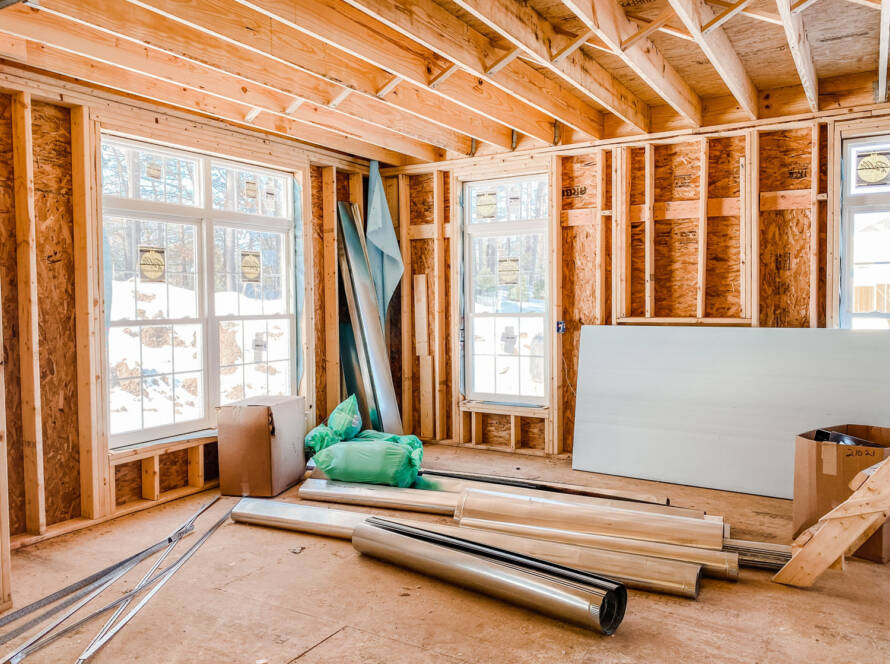
When you walk through a model home, everything looks perfect. The paint is fresh; the furniture is staged. But the “bones” of the house tell the real story.
Production builders are under immense pressure to keep costs down. They often use “Builder Grade” materials where you can’t see them.
- Lumber: They might use lower-grade framing lumber that has more knots and warps over time.
- Windows: They use standard “contractor grade” windows that meet the bare minimum energy code.
- Insulation: They do the minimum required by law.
The Performance Difference
At GreenCraft, as Master Certified Green Professionals, we refuse to compromise on the envelope of the home.
- We use advanced framing techniques (like 2×6 exterior walls) to allow for thicker insulation.
- We seal the crawlspace to control humidity—something most production builders skip because it costs extra.
- We install high-performance windows that block the heat, not just the wind.
You might not “see” these differences on day one, but you will feel them on day 1,000 when your energy bills remain low and your floors don’t squeak.
The Power of “Yes”
The most frustrating word in home building is “No.”
- “Can I add a pot filler over the stove?” No.
- “Can I have a vaulted ceiling in the master?” No.
- “Can I source this antique door from Savannah for my pantry?” No.
Production builders say “No” because “Yes” slows down their assembly line. “Yes” requires thinking. “Yes” requires custom ordering.
At GreenCraft, our default answer is “Let’s figure it out.”
Because we are custom builders, we love the challenge.
- Do you want a secret bookshelf door leading to a man cave? Let’s do it.
- Do you want a dog washing station in the laundry room that matches your kitchen tile? Done.
- Do you want to use reclaimed wood from your grandfather’s barn for the mantle? Bring it in.
Your home should be a reflection of your personality, not a reflection of a builder’s efficiency spreadsheet.
The “Change Order” Myth
There is a misconception that custom buildings are chaotic and filled with expensive “Change Orders.”
Ironically, Production Builders are often the ones who punish you for changes. If you miss their strict “selection deadline” by one day, they charge you a massive penalty fee or simply refuse to make the change. They rely on you not changing anything.
The GreenCraft Reality:
We expect the design to evolve. While we try to lock in decisions early using our 3D visualization tools (so you can see it before you buy it), we know that sometimes, once the framing is up, you realize you want to move a closet door or add an outlet.
We don’t view this as a failure; we view it as refinement. We handle changes transparently. We tell you exactly what it costs (if anything), and we make it happen. We would rather move a wall on paper or during framing than have you live with a layout you hate for 20 years.
Resale Value: Scarcity vs. Commodity
Think about the future. Someday, you might want to sell this home.
If you build in a neighborhood where there are 50 other homes that look exactly like yours (same floor plan, slightly different brick), you are selling a commodity. You are competing on price alone. If your neighbor sells for $500,000, you cannot sell for $550,000, because buyers will just buy the cheaper version next door.
A Custom Home has scarcity value. There is no other house like it.
- The unique layout.
- The higher-end finishes.
- The superior construction quality.
These factors insulate your home’s value. In the luxury market of Hilton Head and Savannah, buyers pay a premium for uniqueness. A GreenCraft home stands out in a sea of sameness.
“Greencraft laid out an aggressive timeline… We trusted Greencraft, and they delivered a quality product.”
— John B., Belfair Plantation
The Relationship: Superintendent vs. Partner
Finally, the biggest difference is who you work with.
With a large builder, you are a number. You might meet the Superintendent once at the “Pre-Drywall Walk,” and then never see them again. You are mostly dealing with a salesperson or a warranty rep.
With GreenCraft Homes, you get Thad Reardon. You get a partner. Thad is on-site daily. He knows your name, he knows your dog’s name, and he knows exactly why you wanted that specific tile in the guest bath.
Building a custom home is a 12-to-18-month marriage. You want to be married to someone who communicates, cares, and is personally invested in the outcome not a corporation that answers to shareholders.
Your Next Step
Are you tired of hearing “No”? Are you frustrated by floor plans that almost work but just aren’t quite right?
Stop trying to force your life into a pre-built box. Come see what “True Custom” looks like. Let us show you how we can design a home around you, with no boundaries and no “standard packages.”
Schedule Your “Blank Sheet” Consultation with GreenCraft Homes
Frequently Asked Questions
Is a custom home always more expensive than a production home?
Generally, yes, the price per square foot is higher because the materials and craftsmanship are superior. However, you often get more value. With a production home, you pay for a lot of wasted space (hallways, formal dining rooms you don’t use). With custom, we design efficiently, so you might need less square footage to get a better lifestyle, which balances the budget.
Do I need to have a set of architectural plans before I call you?
No! In fact, we prefer you don’t. We offer Design-Build services. We can help you design the home from scratch using our 3D software. This is often faster and more cost-effective than hiring an outside architect who may design something over your budget.
Can I build a GreenCraft home in a regular subdivision?
It depends on the neighborhood. Some subdivisions are “Builder Restricted,” meaning only specific production builders are allowed to build there. We build in “Open Builder” communities (like Palmetto Bluff, Savannah Quarters, Hampton Lake) or on private land/lots that you own.
How long does a custom home take to build compared to production?
A production home might go up in 6-8 months because it is an assembly line. A true custom home typically takes 10-14 months, depending on size and complexity. The extra time is spent on detailed craftsmanship, site preparation, and ensuring every custom finish is installed perfectly.
Can I use my own architect?
Absolutely. If you already have a set of plans you love, we are happy to bid on them and build them. We will still review them with our “Builder’s Eye” to suggest cost-saving tweaks or performance improvements before we break ground.
About the Author
Thad Reardon is the Founder and President of GreenCraft Homes. He has spent over 40 years in the construction industry, witnessing the shift from true craftsmanship to mass production.
As an NAHB Graduate Master Builder, Thad founded GreenCraft to be the antidote to the “cookie-cutter” trend. He believes that every family is unique, and their home should be too. He refuses to cut corners for speed, choosing instead to focus on the long-term durability and beauty of the home. He is the author of “So You Wanna Build a Home?”, a guide that empowers homeowners to understand the difference between buying a product and crafting a legacy.